

Biosphere 2 teams bring Mars to Earth, control hydroponics farm remotely
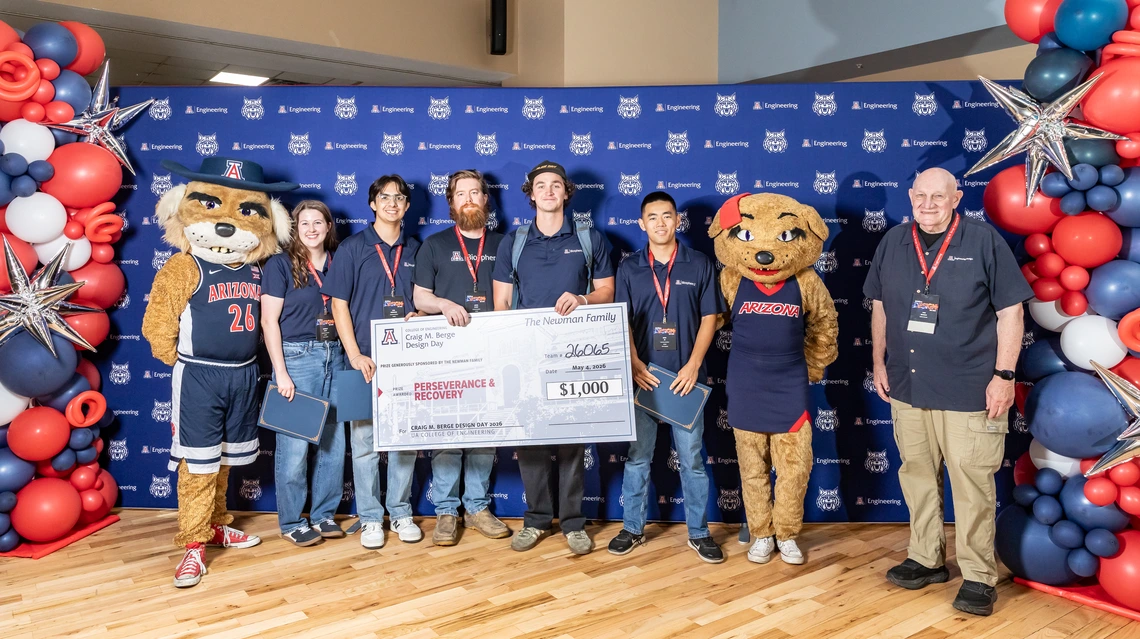
Capstone Team 26065 poses with alum Don Newman (far right) after receiving the Newman Family Award for Perseverance and Recovery for their Mars environmental chamber project at the 2026 Craig M. Berge Design Day.
Supporting future life on Mars begins with growing plants in one of the harshest environments – conditions one capstone team set out to replicate on Earth.
Biosphere 2 sponsored Team 26065 to design and build a high-fidelity environmental chamber to help researchers study how plants could survive in Martian conditions.
"Our project combined real-world experiments with AI-powered digital twins to simulate how life can shape planets," said Isabella Scott, the team's project lead and 2026 mechanical engineering alum.
The team's sealed acrylic chamber recreates key Martian growing conditions by regulating temperature, humidity and atmospheric gas composition while integrating perchlorate-rich soil columns, automated irrigation and full-spectrum grow lights to support soil remediation and plant-growth experiments that explore how plants and soil microbes could help make Martian soil more hospitable.
"If you've seen the movie The Martian, it's a similar concept," Scott said. "We created a chamber that can simulate Martian conditions so researchers can run more realistic experiments."
During the fall semester, the team worked alongside Biosphere 2 researchers to refine system requirements and ensure the design could withstand operating temperatures down to minus 10 degrees Celsius (14 degrees Fahrenheit) to simulate Mars-like conditions.
At the College of Engineering’s 2026 Craig M. Berge Design Day, the team showcased a four-foot acrylic chamber that could support long-term experiments lasting weeks or even months without interruption.
Team 26065 walked away from Design Day with the Newman Family Award for Perseverance and Recovery and $1,000.
"We've all had to stretch outside of our own engineering disciplines and really learn how to communicate with each other," Scott said. "It's pushed us to think about the entire system instead of just one piece."
Restoring remote control

(From left) Benjamin Feuerborn, Kyle Carlsen, Elias Vazquez, Katelyn Miller, Lily Gorrell and Solomon Armenta’s remote monitoring and control system supports Biosphere 2's hydroponic shipping-container farms.
Biosphere 2's hydroponic shipping containers, built by Freight Farms, allow researchers to grow leafy greens and other crops in controlled environments. When the company went out of business, it discontinued the cloud-based software used to remotely monitor sensors and control lighting, irrigation and other growing systems.
Engineering management alum Solomon Armenta led Team 26066 to rebuild it from the ground up. They developed a software platform that connected the existing hardware to a secure cloud-based system.
"We were essentially reverse engineering the software to control everything remotely again," Armenta said.
The team connected the existing Freight Farms hardware to a Raspberry Pi, built a custom cloud platform using Amazon Web Services and recreated the original user interface so researchers could remotely monitor and control the farm.
For Armenta, the experience reinforced that success depends as much on trust and teamwork as technical expertise.
"I couldn't have asked for better teammates," he said. "There's no one else I would rather be in the mud with."